By The Pawline veterinary teamVeterinary-reviewed by Alastair Greenway, BVM&S MRCVS · 25 July 2026
Emerging marker
This marker has no established reference range in dogs or cats yet, so it is read as a trend rather than measured against a threshold.
The Dysbiosis Index is a quantitative PCR measure of gut bacterial balance from a faecal sample — the validated microbiome test, distinct from consumer wellness sequencing. It gives the gut a single number, but it is read against a laboratory-specific scale rather than a universal reference band.
The gut microbiome — the community of bacteria living in the intestine — has become one of the most talked-about areas in health, and one of the most oversold. The Dysbiosis Index (DI), developed by the Texas A&M Gastrointestinal Laboratory, is the serious end of that field: rather than sequencing everything and producing a wellness narrative, it uses quantitative PCR to measure a defined panel of bacterial groups known to shift in gut disease, and condenses them into a single number describing how far the community has moved from a healthy pattern.
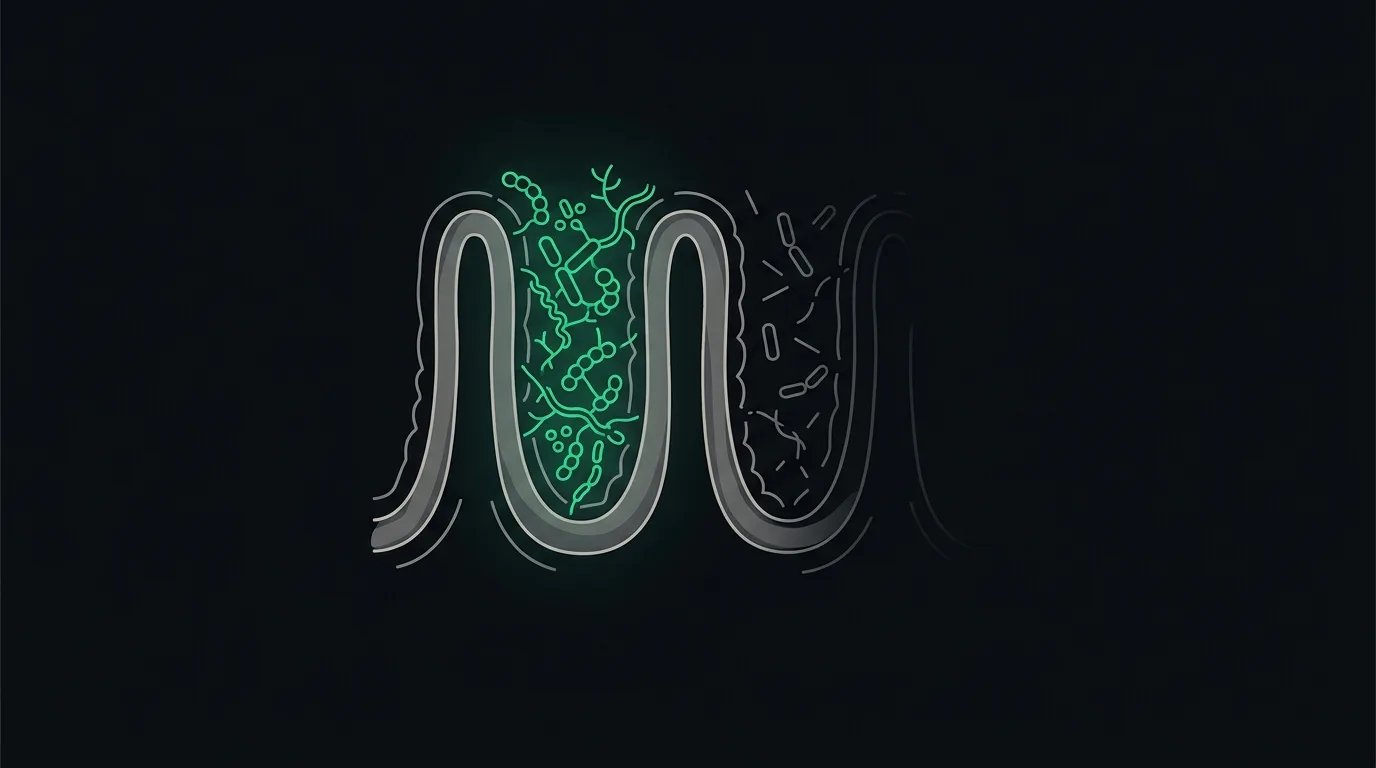
The Dysbiosis Index measures a defined panel of gut bacteria by qPCR and condenses them into one number describing how far the community has shifted.
That design matters. It is a targeted, validated measurement, not an open-ended survey — which is what separates it from the consumer microbiome kits that produce colourful reports of uncertain clinical meaning.
Why this is an emerging marker
The DI sits in the library's frontier layer as "emerging". It is a real, validated, clinically useful assay — but it is interpreted against a laboratory-specific scale rather than a universal reference band shared across labs, and the science of what to do about a given result is still maturing. So here it is:
read as a trend on the same laboratory's assay;
excluded from the in/out-of-range tally and from any health score;
treated as an input to a gastrointestinal work-up, not a diagnosis in itself.
What a raised index might mean
A raised DI indicates the bacterial community has shifted away from the healthy pattern — dysbiosis. This is commonly seen alongside chronic enteropathies (chronic inflammatory gut disease), after antibiotic courses, and in some cases of chronic diarrhoea. Importantly, dysbiosis is often a consequence of gut disease as much as a cause, so a raised index says "the gut environment is disturbed", not "here is the disease". It is read alongside the rest of the gastrointestinal picture — B12 and folate (which map absorption and can themselves signal dysbiosis), TLI, diet history and antibiotic exposure.
What a normal index might mean
A DI within the healthy range suggests the bacterial community is broadly typical, which is reassuring — though it does not exclude gut disease, since inflammatory bowel conditions can exist without a marked microbiome shift. As always, it is one strand of the picture.
In chronic disease
The DI is most useful tracked over time in chronic gut disease: watching whether the community recovers after antibiotics, or as diet and treatment take effect, gives an objective handle on something that otherwise relies entirely on stool quality and appetite. A normalising index alongside clinical improvement is encouraging; a persistently disturbed one may prompt further dietary or therapeutic adjustment.
Cat vs dog
The index was developed and is best validated in dogs, where it is well established; a feline version exists and is developing, but the canine evidence base is deeper. Because scales are lab- and species-specific, results must be read against the correct species scale from the issuing laboratory — and compared only with results from that same laboratory.
How it's measured
The DI is run on a faecal sample by qPCR at a specialist laboratory (Texas A&M GI Lab and equivalents), reported as a dimensionless index against that lab's scale. It is usually run alongside the serum GI panel (B12, folate, TLI). It should not be conflated with consumer microbiome sequencing kits, which measure different things in different ways.
What to do next
A raised Dysbiosis Index is a prompt to look at the gut properly with your vet — diet, antibiotic history, and the wider gastrointestinal panel — rather than a result to treat directly with probiotics on its own. Its real strength is longitudinal: repeated on the same assay, it turns "the gut seems better" into a measurable trend.
This page is educational and is not a diagnosis. Lab results are interpreted in the full clinical context by your veterinary surgeon; a single value rarely tells the whole story.