By The Pawline veterinary teamVeterinary-reviewed by Alastair Greenway, BVM&S MRCVS · 14 August 2026
TSH is the pituitary's instruction to the thyroid, so it moves in the opposite direction to thyroid hormone. In dogs it is the key partner to T4 for confirming an underactive thyroid — a low T4 with a high TSH is the classic combination — and it's the test that helps separate true hypothyroidism from illness-related dips.
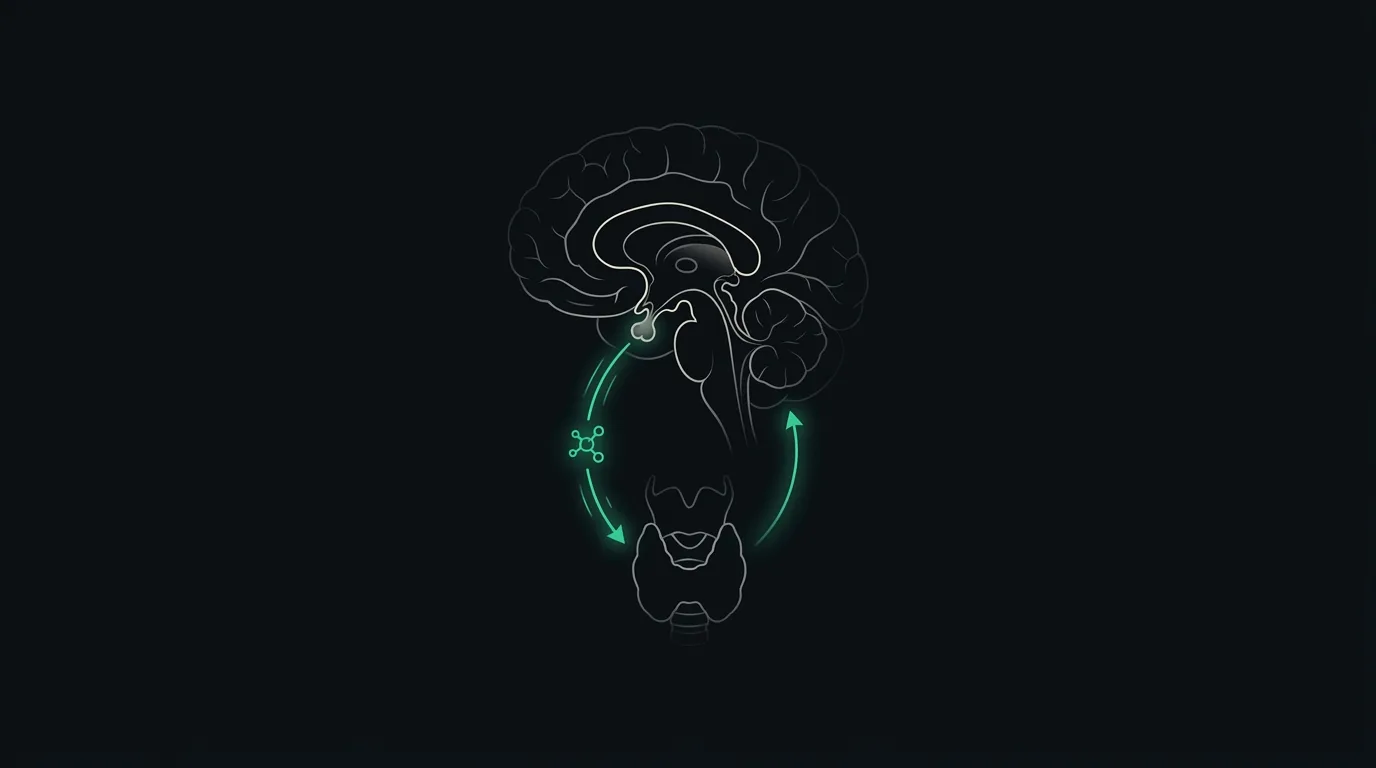
TSH (thyroid-stimulating hormone, or thyrotropin) is not made by the thyroid at all — it is made by the pituitary gland in the brain, and its job is to tell the thyroid how hard to work. The system runs on negative feedback: when thyroid hormone is low, the pituitary senses it and pushes TSH up to drive the gland harder; when thyroid hormone is high, TSH is suppressed down. That inverse relationship is the entire logic of the test.
TSH is the pituitary's instruction to the thyroid, running on negative feedback — so it moves in the opposite direction to thyroid hormone.
Because of that, TSH is almost never read alone. Its value is entirely in the pattern it forms with total T4 and free T4.
The pattern that matters (dogs)
In dogs, the question is usually hypothyroidism (an underactive thyroid), and the diagnostically satisfying combination is:
Low T4 + low free T4 + HIGH TSH → the classic picture of true primary hypothyroidism. The gland is failing, so hormone falls and the pituitary shouts louder.
Low T4 + normal free T4 + NORMAL TSH → points instead towards "sick euthyroid" (non-thyroidal illness), where unrelated disease depresses thyroid readings without the thyroid actually failing. Here the pituitary isn't shouting, because it doesn't perceive a genuine deficit.
That second pattern is why TSH matters so much: it is one of the main defences against misdiagnosing a sick dog as hypothyroid and committing it to lifelong medication it doesn't need.
An honest limitation: canine TSH is not perfectly sensitive — a meaningful minority of genuinely hypothyroid dogs have a TSH that sits within the reference range. So a normal TSH does not by itself exclude hypothyroidism; the diagnosis rests on the whole picture, including clinical signs.
In cats
Feline hyperthyroidism (an overactive thyroid) suppresses TSH, so a cat with hyperthyroidism typically has an undetectably low TSH. A sensitive TSH assay can therefore be useful in borderline cases: a cat with equivocal T4 but a fully suppressed TSH fits early hyperthyroidism, while a clearly detectable TSH argues against it. TSH is also watched in treated hyperthyroid cats to avoid pushing them into an underactive state.
In chronic disease
TSH is used both to confirm a diagnosis and to monitor treatment. In a hypothyroid dog on thyroid supplementation, the aim is to restore hormone levels and see TSH settle back into range — a rising TSH suggests under-treatment. In treated hyperthyroid cats, a TSH that comes off the floor can signal the thyroid has been suppressed too far.
About the reference range
This page deliberately shows no range strip. TSH assays and their reference intervals are method- and species-specific, and Pawline only draws a band where it has a verified interval to draw. Read your result against the range printed on your own report, and compare values over time only within the same laboratory's assay.
Just how method-specific: published canine TSH intervals differ by more than tenfold at the top end between assays (for example an upper limit around 0.4–0.6 ng/mL on some platforms versus figures several times higher on others), so there is genuinely no universal cTSH number to quote — a value only means something against its own assay's reference. The interpretive overlap is real too: TSH is raised in only ~60–85% of truly hypothyroid dogs, while ~10–20% of healthy dogs have a raised TSH — and TSH also rises transiently during recovery from unrelated illness: in one study of acutely ill dogs, a quarter had an elevated TSH at some point in the weeks after discharge, peaking around four weeks out. A raised TSH in a recently-ill dog is therefore repeated once the dog is well, not acted on. All of which is exactly why TSH is read with total T4 and free T4 rather than alone. Read your own report's range.
What to do next
TSH is interpreted with T4, free T4 and the clinical signs — never alone. If your dog has a low T4, TSH is the test that helps decide whether this is true hypothyroidism (TSH high) or the shadow of another illness (TSH normal). In a borderline cat, a suppressed TSH supports early hyperthyroidism. In both, discuss the full thyroid panel with your vet rather than acting on any single number.
This page is educational and is not a diagnosis. Lab results are interpreted in the full clinical context by your veterinary surgeon; a single value rarely tells the whole story.