By The Pawline veterinary teamVeterinary-reviewed by Alastair Greenway, BVM&S MRCVS · 23 August 2026
PTH is the hormone that defends blood calcium. Its number means almost nothing on its own — the question is always whether the level is APPROPRIATE for the calcium measured at the same time. A PTH sitting mid-range alongside a high ionised calcium is not reassuring; it is the abnormal finding.
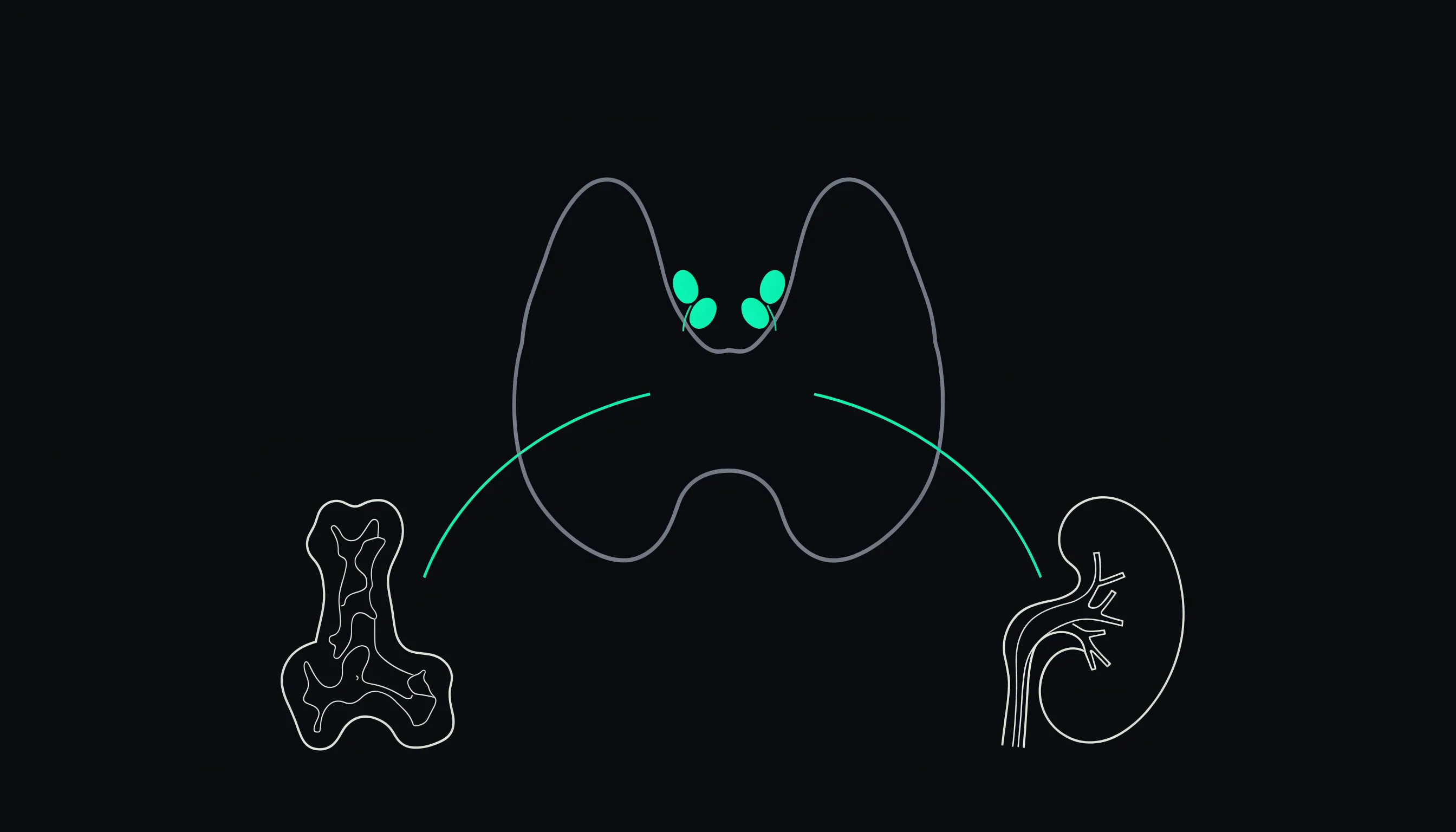
The parathyroid glands are four small structures beside the thyroid, and they do one job: they defend the level of calcium in the blood. When calcium falls, they release parathyroid hormone, which raises it — pulling calcium from bone, recovering more from the urine, and prompting the kidney to activate vitamin D so the gut absorbs more. When calcium rises, PTH release switches off.
Four small glands beside the thyroid defend blood calcium — pulling it from bone, recovering it in the kidney, and prompting the kidney to activate vitamin D so the gut absorbs more.
That feedback loop is the whole reason a PTH result is interpreted the way it is.
Why the number alone tells you nothing
Almost every other test on a panel can be read against its own range. PTH cannot. A value only becomes information once you know what the calcium was doing at the same moment, because the healthy response to a high calcium is a suppressed PTH, and the healthy response to a low calcium is a raised one.
So the diagnostic question is never "is the PTH high?" but "is this PTH appropriate for that calcium?"
The consequence is counter-intuitive and worth stating plainly: a PTH comfortably inside its reference range, measured alongside a high ionised calcium, is an abnormal result. A healthy parathyroid gland faced with high calcium should have switched off. One that has not is behaving autonomously — and that inappropriately-normal PTH is compatible with primary hyperparathyroidism.
This is why PTH is almost always run on the same sample as ionised calcium, and why a PTH sent without one is difficult to act on.
Reading it alongside calcium
High or inappropriately normal PTH with high ionised calcium points towards primary hyperparathyroidism — usually a benign tumour (adenoma) of one gland, sometimes hyperplasia, occasionally a carcinoma. The classic accompanying picture is a low phosphorus and urine that is not being concentrated. Reported in both dogs and cats, it is the situation the test exists to catch.
High PTH with low or low-normal ionised calcium is the gland doing its job in difficult circumstances — secondary hyperparathyroidism, where something else is dragging calcium down and the parathyroids are compensating. In practice the commonest driver is chronic kidney disease: retained phosphorus, less activated vitamin D, and a calcium the glands are working to hold up. The rise in PTH here is a consequence, not the disease.
Low PTH with low ionised calcium is the gland failing to respond — hypoparathyroidism, uncommon but important, since the low calcium is what makes the animal unwell.
In kidney disease
Renal secondary hyperparathyroidism develops through a tangle of interacting signals — phosphorus retention, reduced calcitriol production, and FGF-23, which rises earliest of all. PTH is one reading of that process rather than the whole of it, and it is usually interpreted alongside phosphorus and the kidney markers rather than by itself. Controlling phosphorus is the usual lever.
Cat vs dog
The physiology is the same in both. Primary hyperparathyroidism is uncommon in each, and rather less often reported in cats. In cats the more frequent context for an abnormal calcium is different — idiopathic hypercalcaemia and neoplasia both feature — so a raised calcium in a cat does not lead as directly to a parathyroid answer as it might in a dog.
About the reference range
This page shows no range strip. PTH assays are species-validated and laboratory-specific, results are not comparable between methods, and — as above — the interval is not what makes the number meaningful. Pawline draws a band only where it holds a verified interval, so PTH is presented as an explainer. Read your result against your own report's range, and always beside the ionised calcium from the same sample.
PTH is also sensitive to sample handling: it degrades if the sample is not separated and kept cold promptly, which is one reason it is usually a send-out test with specific instructions rather than something run on the practice analyser.
What to do next
PTH is a second-line test, ordered to explain a calcium abnormality that has already been found and confirmed on ionised calcium rather than on total calcium alone. If it has been recommended for your pet, the useful preparation is making sure the ionised calcium is measured on the same sample, and that your vet has the full medication list — vitamin D supplements and some topical psoriasis preparations meant for people are a genuine and easily-missed cause of a high calcium in animals.
This page is educational and is not a diagnosis. Lab results are interpreted in the full clinical context by your veterinary surgeon; a single value rarely tells the whole story.