By The Pawline veterinary teamVeterinary-reviewed by Alastair Greenway, BVM&S MRCVS · 25 July 2026
Reference range · mg/dL
00.3
Reference
0–0.3
Direction
Higher values are the concern.
This is the conventional reference interval. Your pet’s own report may print a slightly different range, so always read the value against that. Sign in to see your pet’s value on this strip.
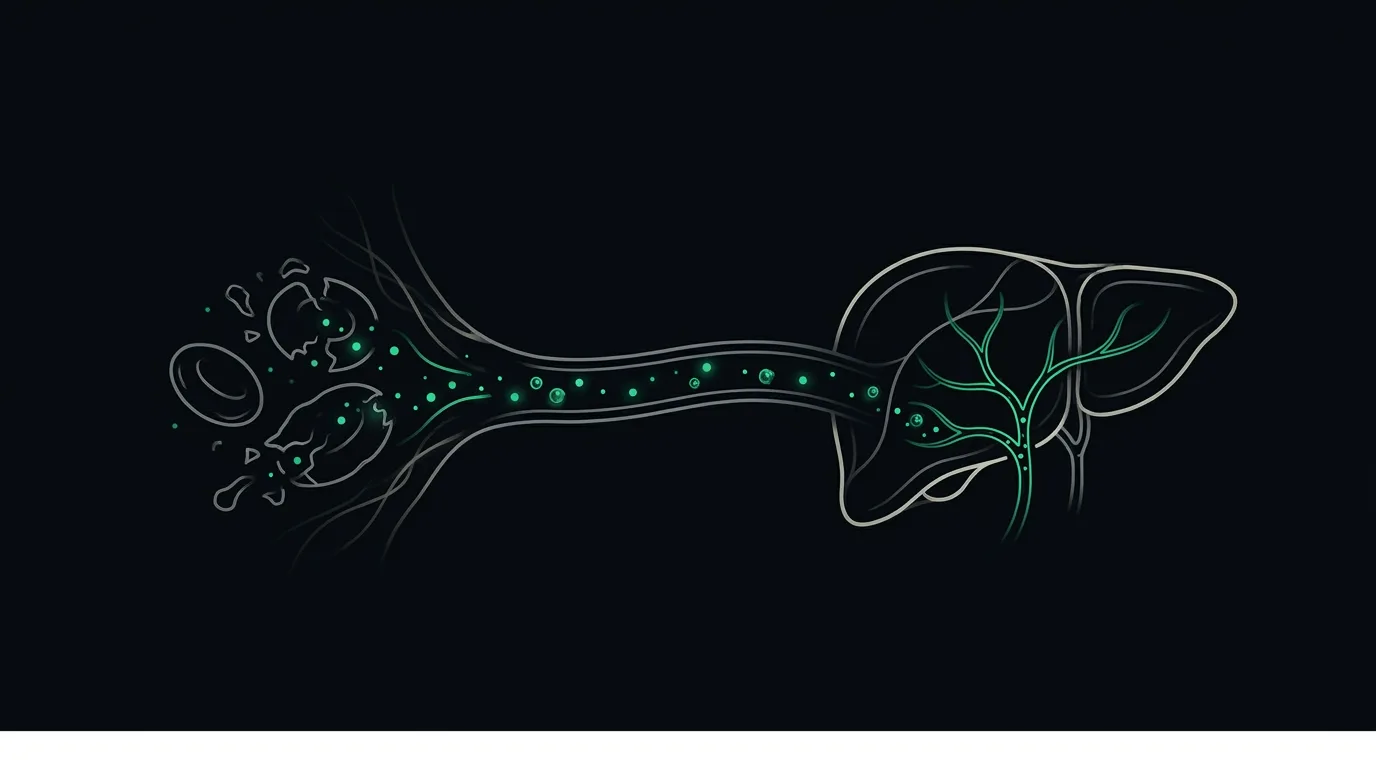
Bilirubin is the pigment left over when old red blood cells are broken down; the liver processes it and sends it out in bile. A clear rise causes the yellow tinge of jaundice and points to one of three things — accelerated red-cell breakdown, liver disease, or blocked bile flow — and always warrants prompt veterinary attention.
Bilirubin is a yellow-orange pigment produced when the body recycles worn-out red blood cells. The liver takes up this pigment, chemically processes ("conjugates") it, and excretes it into bile, which drains through the bile ducts into the gut. Because bilirubin passes through this whole chain, a rise can come from a problem at any point along it — which is exactly what makes it informative.
Bilirubin is the pigment from broken-down red cells; the liver processes it into bile. A rise points to red-cell, liver, or bile-flow problems.
Unlike many markers, even a modest clear elevation of bilirubin is significant and rarely benign, so it always prompts a closer look.
Reading a high result
A raised bilirubin (hyperbilirubinaemia) — and, when marked, the visible jaundice that comes with it — is classically divided by where the problem sits:
Before the liver (pre-hepatic): accelerated red-cell breakdown (haemolysis) floods the system with pigment faster than the liver can clear it. This is often accompanied by anaemia on the blood count (haematocrit).
The liver itself (hepatic): liver disease reduces the liver's ability to process and excrete bilirubin. Other liver markers (ALT, ALP) are usually abnormal too.
After the liver (post-hepatic): an obstruction to bile flow — gallbladder disease, a bile-duct blockage, or pancreatitis pressing on the duct — backs bilirubin up. GGT and ALP tend to rise.
Sorting between these is the main diagnostic task, and it is done with the red-cell count, the rest of the liver panel, and imaging. Because a blocked bile duct, a haemolytic crisis and significant liver disease are all serious, a clearly raised bilirubin is treated as something to investigate without delay.
Reading a low or normal result
A normal bilirubin is reassuring and is the expected state. Low bilirubin has no clinical significance. Because bilirubin only rises once the liver's large reserve capacity to handle pigment is overwhelmed, a normal value does not exclude milder liver disease — which is why it is read alongside the enzyme markers rather than relied on alone.
In chronic liver disease
In established liver or bile-duct disease, bilirubin is a marker of severity and of bile flow. A rising bilirubin signals worsening cholestasis or failing liver function and often marks a more advanced stage; a bilirubin that settles back towards normal is a tangible sign of improvement. Because it reflects the functional end of the liver's job (excretion) rather than mere enzyme leakage, it complements ALT and ALP in tracking how a liver patient is really doing.
Cat vs dog
Bilirubin is interpreted the same way in both species. In cats, jaundice with a raised bilirubin frequently accompanies hepatic lipidosis (fatty liver) and cholangitis, and any anorexic, jaundiced cat is an urgent case. In dogs, immune-mediated haemolysis is a common pre-hepatic cause, while gallbladder disease is an important post-hepatic one. In both, the same three-way question — red cells, liver, or bile flow — organises the work-up.
How it's measured
Total bilirubin is measured on a routine chemistry panel, in mg/dL (US) or µmol/L (UK/SI); some panels also split it into conjugated and unconjugated fractions to help localise the cause. A haemolysed or lipaemic sample can interfere, so clean collection matters. Read the value against your own report's range.
What to do next
Because a clearly raised bilirubin is rarely trivial, it warrants prompt discussion with your vet and usually a structured work-up: a blood count to check for haemolysis, the full liver panel, and imaging of the liver, gallbladder and bile ducts. Identifying which of the three compartments is responsible is what turns the finding into a plan.
Reference ranges reflect conventional laboratory intervals. Always interpret against your own lab's printed range and your veterinary surgeon's judgement. A brighter optimal band is shown only where a published guideline defines one, and it is cited.
This page is educational and is not a diagnosis. Lab results are interpreted in the full clinical context by your veterinary surgeon; a single value rarely tells the whole story.