By The Pawline veterinary teamVeterinary-reviewed by Alastair Greenway, BVM&S MRCVS · 25 July 2026
Reference range · U/L
10125
Reference
10–125
Direction
Higher values are the concern.
This is the conventional reference interval. Your pet’s own report may print a slightly different range, so always read the value against that. Sign in to see your pet’s value on this strip.
ALT is an enzyme that lives inside liver cells and leaks into the blood when those cells are stressed or damaged, so a raised ALT points towards the liver. A single mild elevation is common and often passes; a sustained or rising level across repeat tests is the more meaningful signal, and the height of the number does not reliably tell you the cause.
ALT (alanine aminotransferase, historically SGPT) is an enzyme concentrated inside hepatocytes, the working cells of the liver. Healthy cells keep it tucked away; when a hepatocyte is injured or its membrane becomes leaky, ALT spills into the bloodstream and the blood level rises. In dogs and cats ALT is fairly liver-specific, which is why it is one of the first numbers a vet looks at when the liver is in question.
It is important to understand what ALT does and doesn't tell you. It is a marker of hepatocyte leakage, not of how well the liver is doing its job. A pet can have a raised ALT with entirely normal liver function, and (less commonly) failing liver function with an unremarkable ALT. That is why ALT is read as part of a group: alongside ALP and GGT (which flag the bile system), bilirubin, and function tests such as albumin and bile acids.
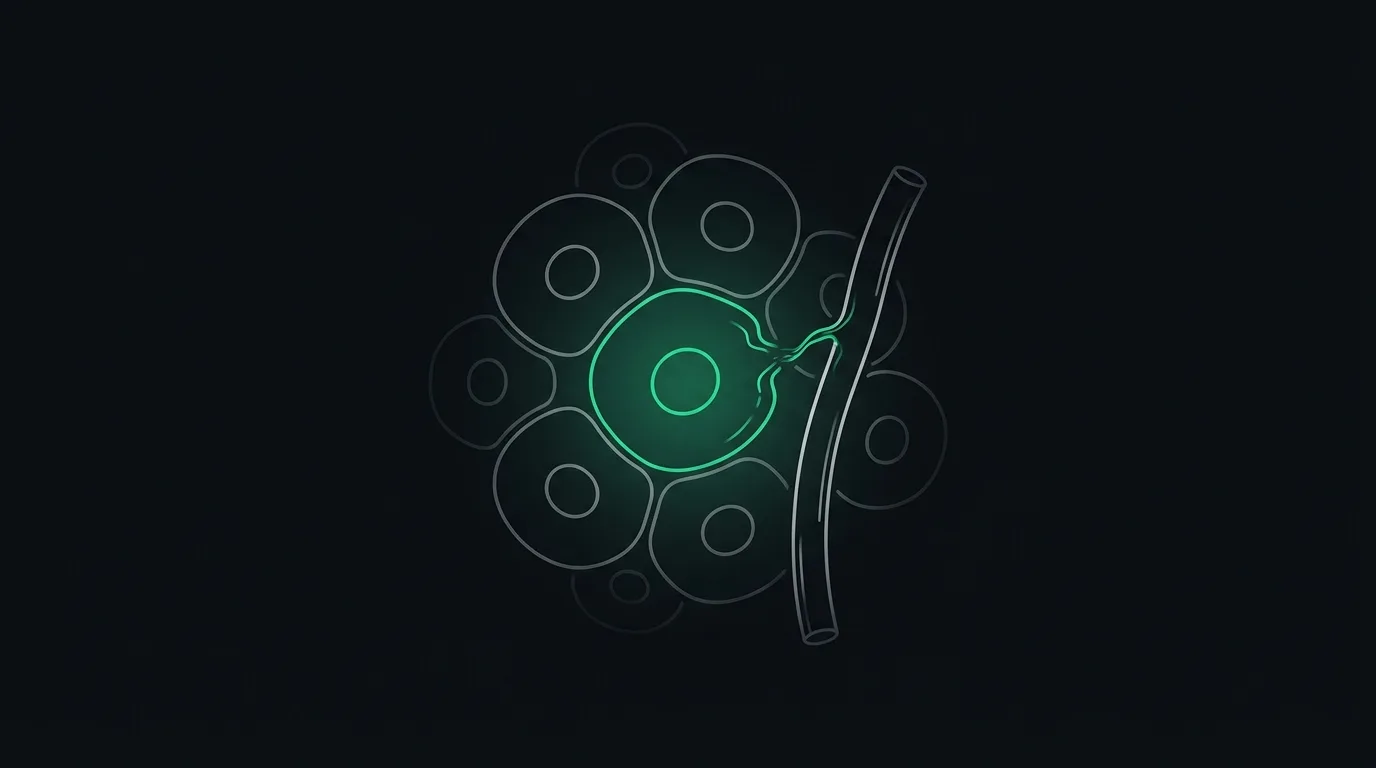
Liver cells hold ALT inside them; when a cell is injured its membrane leaks and ALT escapes into the bloodstream, which is why a raised ALT points to the liver.
Reading a high result
A raised ALT tells you liver cells are leaking; it does not, on its own, tell you why. The list of possibilities is broad: reactive change from an unrelated illness elsewhere in the body, inflammation (hepatitis), fatty change, toxins or medicines, reduced blood flow, endocrine disease such as Cushing's, and, less often, primary liver disease or tumours (Webster et al., 2019). Crucially, the magnitude of the rise does not reliably indicate the cause or the severity: a big spike can follow a self-limiting insult, while a modest, persistent elevation can accompany a smouldering chronic process.
Two features make a high ALT more significant. The first is persistence: a value that stays up, or climbs, across repeat samples several weeks apart is more concerning than a one-off. The second is company: an ALT rise accompanied by raised bilirubin, falling albumin, or clinical signs (poor appetite, vomiting, jaundice, drinking more) moves the liver up the priority list and usually prompts imaging and further testing.
Reading a low or normal result
ALT that sits within the reference range is reassuring about active hepatocyte injury, and a low ALT is not something to worry about. As with all liver markers, "normal ALT" does not completely exclude liver disease (some chronic and end-stage conditions run with normal or even low enzyme levels because there are fewer cells left to leak), so it is always interpreted alongside the rest of the panel and the clinical picture.
In chronic liver disease
The liver has a large functional reserve and a real capacity to repair, so many liver conditions are slow and quiet in their early stages. This is where serial ALT measurements earn their keep. A single value is a snapshot; a trend line reveals whether a process is settling, stable, or advancing. An ALT that drifts steadily upward over months, even within or just above the range, can be the first objective sign of a chronic hepatopathy that has not yet produced symptoms, and it is often what prompts the investigations (imaging, bile acids, sometimes biopsy) that reach a diagnosis while treatment is still most effective. Conversely, watching an elevated ALT fall back towards normal is a reassuring, measurable sign that a liver insult is resolving.
Cat vs dog
ALT is a useful liver marker in both species, but the emphasis differs. In dogs ALT is joined by ALP, which is very sensitive but famously non-specific. Canine ALP rises with steroids, some medicines, bone growth and endocrine disease as readily as with liver problems, so ALT helps anchor the interpretation. In cats ALP has a much shorter half-life and rises less readily, which paradoxically makes any elevation of ALP or ALT in a cat more clinically meaningful, and raises the index of suspicion for conditions such as hepatic lipidosis and cholangitis. GGT helps refine the picture in both species. The direction of these markers together, not any single one, is what localises the problem.
How it's measured
ALT is measured from a routine blood chemistry panel and reported in U/L. No special preparation is needed, though a fasting sample reduces the chance of lipaemia (fat in the sample) interfering with the reading. Reference intervals differ between laboratories and analysers, so read the result against the range printed on your own report and, where possible, follow the trend on the same lab's assay rather than comparing an absolute number between labs.
What to do next
A mildly raised ALT on an otherwise well pet is frequently rechecked in a few weeks before anything more is done, and many resolve. A markedly raised, persistent, or rising ALT, or one keeping company with other abnormal liver markers or clinical signs, warrants a fuller work-up with your veterinary surgeon: bile acids to assess function, imaging to look at the liver's structure, and a review of any medicines. As ever, the number opens the question; the trend and the surrounding tests answer it.
Reference ranges reflect conventional laboratory intervals. Always interpret against your own lab's printed range and your veterinary surgeon's judgement. A brighter optimal band is shown only where a published guideline defines one, and it is cited.
This page is educational and is not a diagnosis. Lab results are interpreted in the full clinical context by your veterinary surgeon; a single value rarely tells the whole story.