By The Pawline veterinary teamVeterinary-reviewed by Alastair Greenway, BVM&S MRCVS · 23 August 2026
Reference range · U/L
10200
Reference
10–200
Direction
Higher values are the concern.
This is the conventional reference interval. Your pet’s own report may print a slightly different range, so always read the value against that. Sign in to see your pet’s value on this strip.
CK is a muscle enzyme that leaks into the blood when muscle cells are disturbed. It is exquisitely sensitive and rises for reasons as ordinary as a struggle on the consulting table, so a modest elevation on its own is usually innocent. Large or persistent rises point at genuine muscle injury, and in cats a rise can accompany a period of not eating.
Creatine kinase is an enzyme that muscle cells use to manage their energy supply. It sits in the cytoplasm — the fluid interior of the cell — in skeletal muscle and heart muscle above all, with smaller amounts in brain tissue. Like ALT in the liver, it is a leakage enzyme: it does no work in the bloodstream, and it appears there only because a cell has let it out.
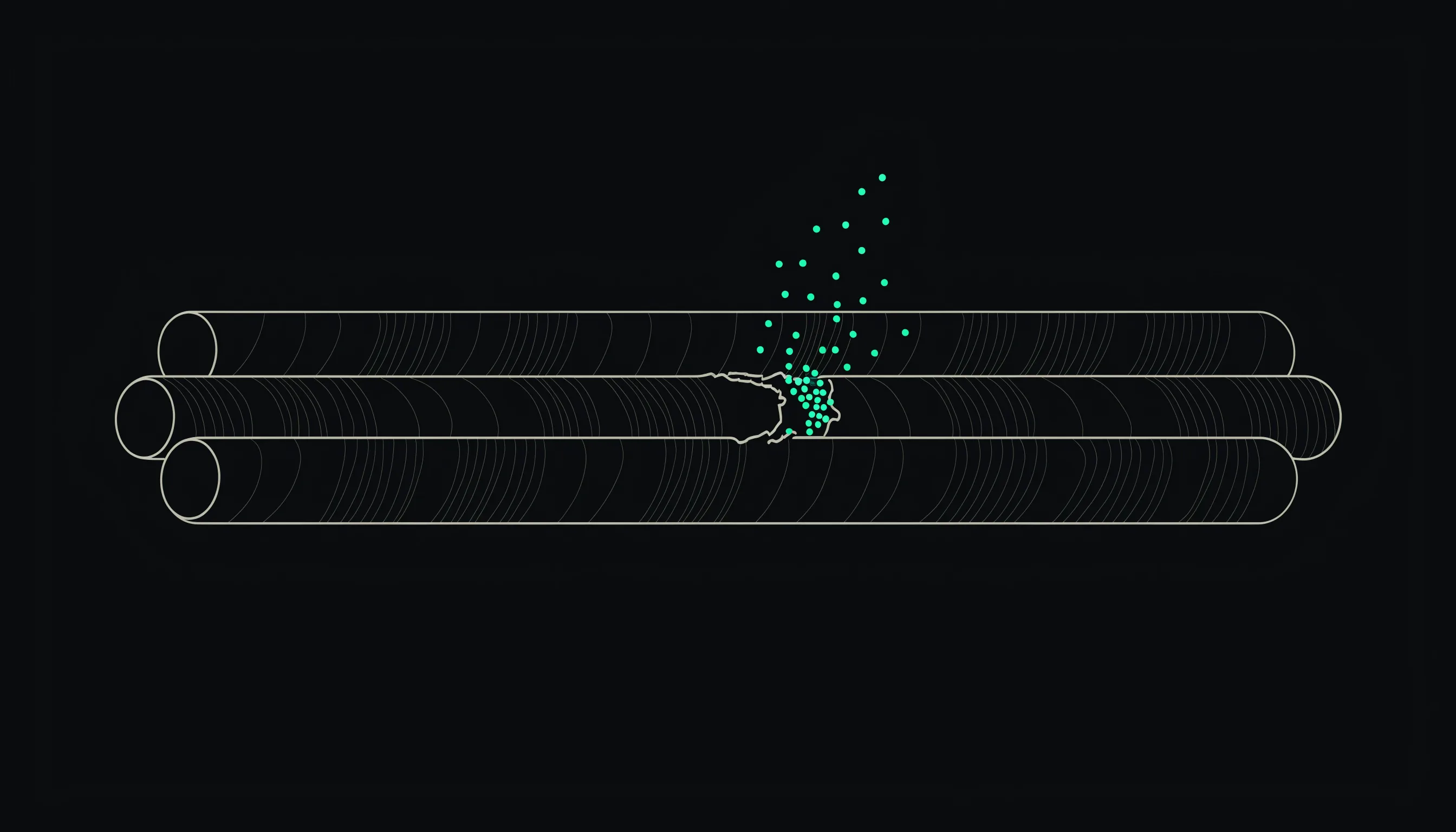
CK sits inside muscle cells; when a fibre is disturbed, the enzyme escapes into the blood.
That single fact explains most of what is confusing about CK. The cell does not have to be badly damaged for some enzyme to escape, so the test is very sensitive and not at all specific. It answers "has muscle been disturbed?" and never "why".
Reading a high result
A raised CK means muscle has released enzyme. The interesting question is always how much, and does anything else agree.
Ordinary causes, and they are common:
A difficult blood draw or a struggle on the table. Restraint and a tense, wriggling patient are enough. This is probably the single commonest reason for a mildly raised CK on an otherwise unremarkable panel.
An intramuscular injection in the preceding day or two — the needle disturbs muscle fibres directly.
Exercise, particularly if unusual for that animal.
Recumbency — an animal that has been lying still and unable to shift position.
Causes that matter:
Trauma, including road accidents, falls and crush injuries.
Inflammatory muscle disease (myositis), where the immune system attacks muscle.
Muscle degeneration, inherited or acquired.
Extensive muscle breakdown (rhabdomyolysis), where a large volume of muscle is injured at once.
The size of the rise is the most useful discriminator available. A CK a little above its interval on a healthy-looking animal, with everything else normal, rarely survives a repeat test. A CK many multiples above, or one that keeps climbing across repeated samples, is a different statement.
Why AST is measured alongside it
AST is present in both liver and muscle, which normally makes it awkward to interpret — but paired with CK it becomes genuinely informative, because the two enzymes clear from the blood at different speeds. CK rises quickly after muscle is disturbed and falls away quickly once the disturbance stops. AST rises more gradually and stays elevated for longer.
So the pattern carries timing information:
CK up, AST normal or barely raised — something disturbed muscle very recently, and there is a good chance it was the sampling itself.
CK up and AST up — a more substantial or more sustained muscle event.
CK settling while AST remains up — muscle injury that has stopped, with the slower enzyme still clearing.
Where AST is raised and CK is not, muscle is an unlikely source and the liver panel — ALT, ALP, GGT — is the place to look.
Cat vs dog
The enzyme behaves the same way in both species, with different reference intervals, but there is one feline association worth knowing.
In cats, a raised CK can accompany a period of not eating. A cat that has been anorexic breaks down its own muscle for energy, and CK activity rises with that catabolism; it has been proposed as a marker of nutritional state in ill cats. In at least one documented case an anorexic cat with progressively rising CK was found on biopsy to have a genuine necrotising myopathy, so the association is not merely a laboratory curiosity.
This matters practically because prolonged anorexia in a cat is already an urgent problem in its own right. A raised CK in a cat that has gone off its food is best read as one more reason to take the not-eating seriously, rather than as a separate muscle diagnosis.
Reading a low result
A low CK carries no established clinical meaning. Reference laboratories do not treat it as a finding, and Pawline does not either. The useful direction for this analyte is upward.
In chronic disease
Followed over time, CK tracks the activity of a muscle problem rather than its severity. In inflammatory muscle disease it typically falls as treatment takes effect and rises again with a relapse, which makes serial measurements more informative than any single value. Because it also responds to entirely benign events, a single unexpected rise in a monitored animal is worth repeating before it is acted on.
About the reference range
Reference intervals for CK are laboratory- and method-specific, and the analyte is more sensitive than most to how the sample was taken and handled — haemolysis alone can lift it. Read your result against the range printed on your own report, and treat a small excursion above it with the sampling in mind.
What to do next
A modest isolated rise, with a well animal and a normal AST, is most often repeated rather than investigated. A large rise, a rising trend, or a rise alongside weakness, a stiff or reluctant gait, pain on handling the muscles, or dark urine deserves prompt veterinary attention: the differential includes conditions that respond well to treatment and some that are time-critical. In a cat that has stopped eating, the CK is a supporting observation and the anorexia is the priority.
Reference ranges reflect conventional laboratory intervals. Always interpret against your own lab's printed range and your veterinary surgeon's judgement. A brighter optimal band is shown only where a published guideline defines one, and it is cited.
This page is educational and is not a diagnosis. Lab results are interpreted in the full clinical context by your veterinary surgeon; a single value rarely tells the whole story.