By The Pawline veterinary teamVeterinary-reviewed by Alastair Greenway, BVM&S MRCVS · 25 July 2026
Emerging marker
This marker has no established reference range in dogs or cats yet, so it is read as a trend rather than measured against a threshold.
Serum 25-hydroxyvitamin D is the storage form of vitamin D and, unlike in people, in dogs and cats it comes almost entirely from the diet rather than sunlight. Lower status tracks inflammation, several cancers, and cardiac and kidney disease — but laboratory methods disagree markedly, so there is no settled universal reference band.
Vitamin D is best known for bone health, but its receptors sit in tissues throughout the body, and it plays a wide role in immune regulation and cell behaviour. Measuring 25-hydroxyvitamin D — the storage form — is the standard way to assess vitamin D status.
The single most important species fact: dogs and cats cannot make meaningful vitamin D in their skin. Unlike people, they do not synthesise it from sunlight; they depend almost entirely on dietary intake. That makes their vitamin D status largely a function of what they eat, and means a low level says something about diet and absorption rather than about time spent outdoors.
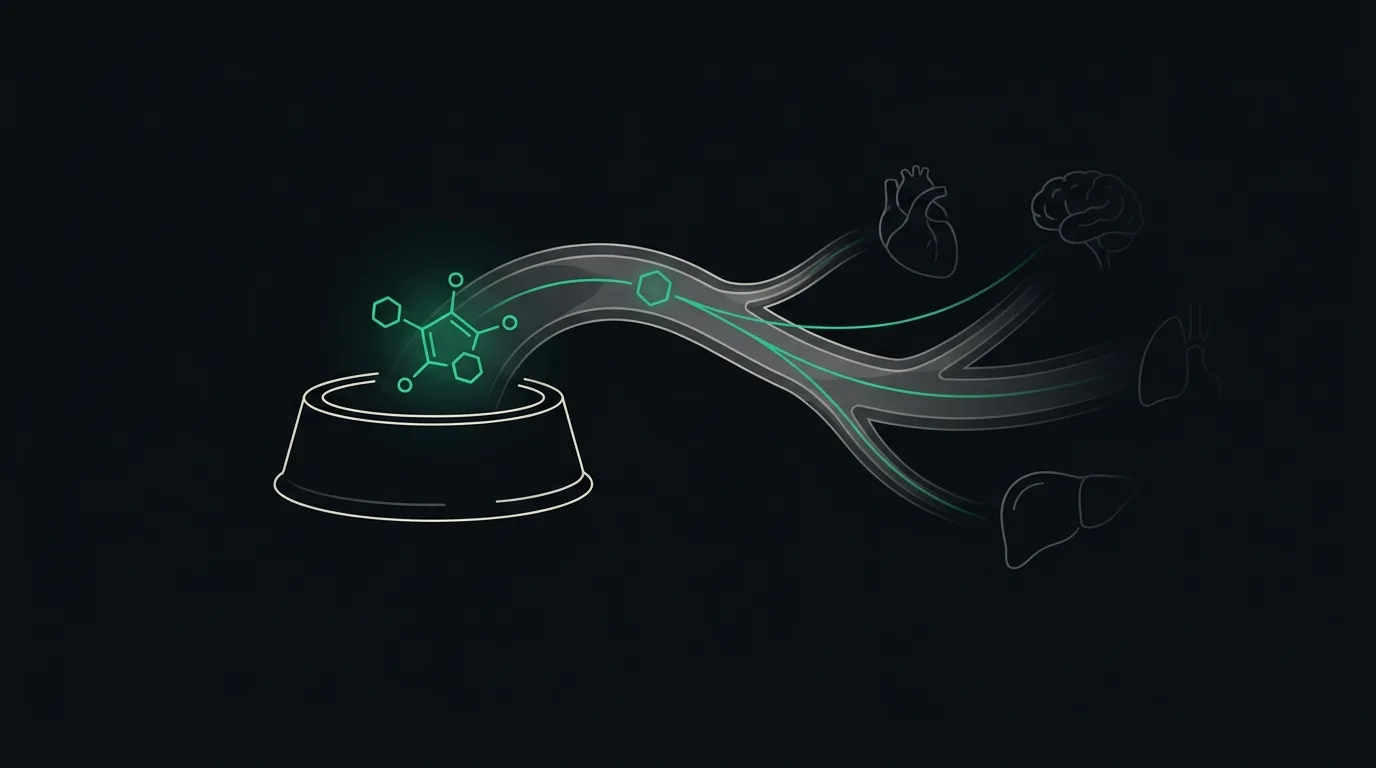
In dogs and cats vitamin D is diet-derived, not made in the skin — so status reflects intake and absorption rather than sun exposure.
Why this is an emerging marker
Vitamin D sits in the frontier layer as "emerging". It is measurable at reference laboratories, and the research linking lower status to disease is genuine and growing. But the assay methods disagree markedly between laboratories, so a value from one lab is not directly comparable with another's, and there is no settled universal reference band in dogs or cats. So here it is:
read as a trend against one laboratory's method;
excluded from the in/out-of-range tally and any health score;
never converted into a threshold-based finding or a supplementation prescription by itself.
What lower status might mean
Research associates lower vitamin D status with inflammation, several cancers, cardiac disease, chronic kidney disease and inflammatory bowel disease in dogs. An important caution runs through that literature: much of it is associational, and in chronically ill animals low vitamin D may be partly a consequence of illness (reduced intake, malabsorption, inflammation) rather than a cause. So a low result is a reason for interest and for reviewing diet and gut absorption — not proof that supplementing will change outcomes.
Why supplementing is not a casual decision
Vitamin D is fat-soluble and can be toxic in excess. Over-supplementation causes dangerous rises in calcium and can damage the kidneys — a genuine, documented harm in dogs. So unlike, say, B12, this is emphatically not a marker to act on independently. Any change to vitamin D intake should be made with veterinary guidance, and monitored.
Cat vs dog
Both species are diet-dependent for vitamin D, and both lack a settled universal reference band; the research base is somewhat fuller in dogs. Complete commercial diets are formulated to supply adequate vitamin D, so deficiency in a well-fed pet on a complete diet is uncommon — home-prepared or unbalanced diets, and malabsorptive gut disease, are the more likely routes to low status in either species.
How it's measured
25-hydroxyvitamin D is measured from a blood sample at reference laboratories (such as Michigan State, Antech and VDI), reported in ng/mL or nmol/L. Because methods differ substantially, only results from the same laboratory and assay should be compared over time, and inter-lab comparison is unreliable.
What to do next
A low vitamin D result is a prompt to review diet and gut absorption with your vet, and to consider whether chronic illness is contributing — not a signal to start supplementing on your own, given the real risk of toxicity. Tracked on a single assay alongside calcium and the clinical picture, it adds an emerging dimension to nutritional and inflammatory assessment.
This page is educational and is not a diagnosis. Lab results are interpreted in the full clinical context by your veterinary surgeon; a single value rarely tells the whole story.